


Setting up a Defensive Wall

As a goalkeeper it is your responsibility to CALL and SET the number of players you want in the wall to defend a free-kick.
The above chart indicates the normal options for amount of players in a wall in order to maximise the difficulty of a direct shot at goal by the opposition. In the professional game you might see, especially when the kick is directly in front of the goal, more players in the wall due to the quality of their distribution or ability to still hit the target.
When calling for the number of players for the wall also clealy indicate the number with your fingers.
For setting of the wall with 1 - 2 / 2 - 3 / 3 - 4 players, you should position the ‘inner’ player, who would be nearest the goal-line, to be in line with your goal-post. The other player/s should then be shoulder to shoulder with this player to avoid any gaps in the wall.
When setting the 5 player wall it should be central to your goal.
You should practice the setting up of a wall in training as in a game it needs to be done quickly. Part of your practice is working with nominated player/s who will assist you in preparing the wall and passing on your instructions, generally that player will be the ‘inner’ player of the wall.
Kicking– An Introduction
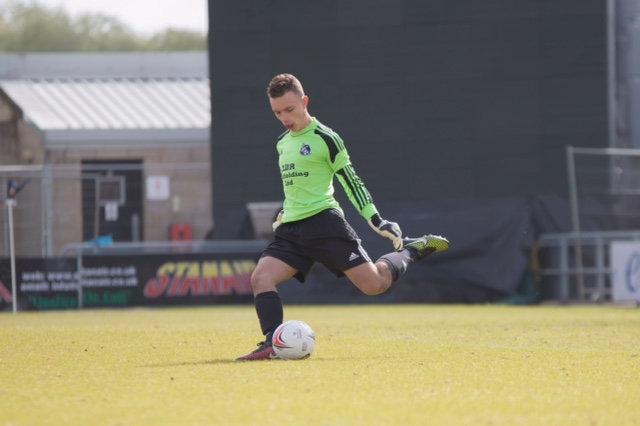
In later releases I will produce a coaching article on kicking methods and how to improve your kicks but if like many goalkeepers (especially at a younger age) you are struggling with your kicks my best advice is to get personal coaching so that a professional can look at all the aspects that make up this important area; such as your balance and approach, your power through the ball, the follow through and many other elements.
 |
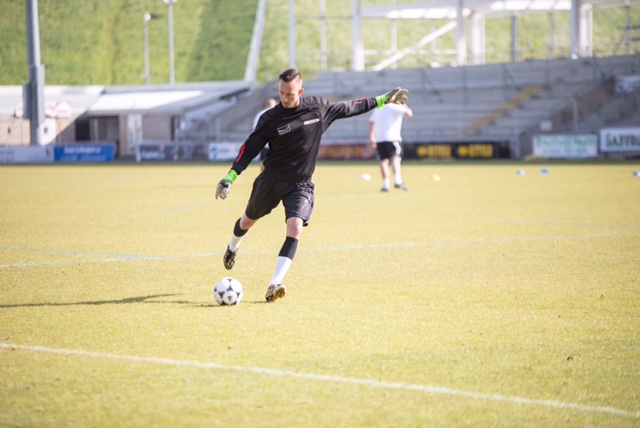 |
This article is purely an introduction as to the key areas that need to be developed in order for you to perform well in this part of your game. Not many goalkeepers to start find kicking naturally, they have developed it by practise, so do not be pressurised into what you cannot do so it affects your game, better to adapt if this is a weakness while you practise to improve this skill. Yes some goalkeepers will be natural at kicking and only need to work more on their accuracy and power. If you do struggle at first, remember that with practice and increase of strength this will become better. Do not demand too much from yourself as this can create issues with your confidence which could remain for some time. Make it an area that you know you will have to work more on!
There are three key elements to kicking: These are the areas you should work on most. There order is also important: -
Technique:
In a future article you will see what methods are used; you will need to adapt these so they become natural to you. Once you have developed a natural and comfortable technique that works well for you work to achieve accuracy.
Accuracy:
It is vital that you learn to perform well in this area as you will be expected to distribute to your team via a number of kicking methods – goal kicks / free kicks / back pass / hand kicks etc. Once you have a good balanced technique with accuracy you can then develop your maximum power into the kicks.
Power:
This will depend on age and strength and if your technique is correct. In a future article I will refer to ‘muscle memory’, this you will develop with age and practise, so do not expect to achieve distances with your kicking too much beyond your age level.
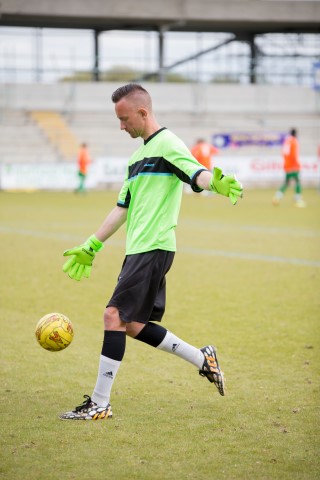 |
Your ability to perform well in all situations where you will be required to kick is important, so practice to obtain perfection by working on each area separately. Work to achieve a standard that you will still be able to handle even when under pressure within a game situation.
This release is primarily designed to inform you of the basic elements you will need to work on to maximise your kicking skills but also to address any lack of confidence you may have. For many years I have seen good GK’s ruin the rest of their performance in a game because their ‘mind-set’ is overtaken due to poor kicks; the expectation that you should be able to kick like other GK’s; and the ‘pressure coaching’ to force improvement without the understanding of why it is happening! With correct application and coaching be assured you will become better, so understand that weakness, do not add to it!
Tip: You or your manager could help improve performance if you coach the out-field players to know any limitations you may have in your kicking capabilities. Do not try or force more than what you can naturally do during a game as this will add to further pressures if incorrectly completed which in turn might affect other areas of your game. Better to work on improving your kicks in a coaching/training session.

 Visit theKeeper.co.uk for goalkeeping news and other general information.
 Coaching sets from basic to advanced to help improve your goalkeeping skills.
 Watch the exciting new video from thekeeper.co.uk here, enjoy!


